
Merton Council wants to build a caged artificial grass pitch (AGP), with floodlights, on Sir Joseph Hood Memorial Playing Field. This is a very controversial move from the professed ‘Borough of Sport’. While the plans are supported by some (but not all) in sporting circles, they are opposed by the wider community and the Friends of Sir Joseph Hood. The proposals have the potential to be the thin end of the wedge, and are ultimately the privatisation of the park, a much valued public amenity.
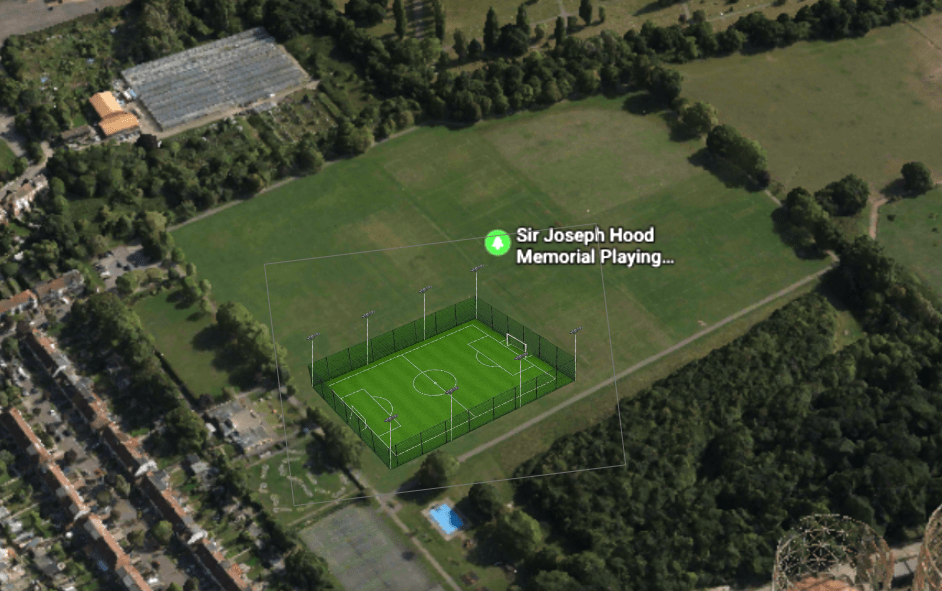
It is important to recognise that the park is used by a variety of users and they all need to be accomodated. The Friends have always tried to do this, raising funds to provide and improve the current sporting facilities. However, the AGP is being imposed on the park for reasons that remain unclear beyond “there is a shortage of artificial pitches in Merton”.
Football has been played in the park for nearly a century. It is dominated by Little League on Saturdays and Motspur Park FC on Sundays, with hundreds of kids running around on the grass. Occassionally it gets called off due to waterlogged ground, but that is the nature of winter sports. It is highly likely hundreds of kids will still be running around on the grass for years to come, as they are unlikely to benefit from the AGP.
Who then benefits from the AGP? Those who can afford to pay for it, including most likely corporate events and Fulham FC / Foundation.
Who could lose out? Quite a long list potentially:
- Those kids currently playing on the site who risk being pushed out by new potential users, not just for sporting space but car parking space (only 39 spaces).
- Other park users, who will suffer a loss in visual amenity on designated Metropolitan Open Land. Many prefer a relaxed atmosphere, and choose to visit the park at quieter times. However, with organised football, 12 hours a day, every day, rather than just Saturdays and Sundays, that would no longer be possible in this small park.
- Other sports may suffer as a result. Will Wimbledon Hawks (Aussie rules) be able to host multiple games in summer? Has the Council’s desire to also introduce two cricket squares been forgotten? This will come into conflict with the AGP, and Aussie rules in a smaller park.
- Marina Avenue residents who will have to endure the shouting and floodlights, and increased congestion on their narrow cul-de-sac.
The wildlife is, of course, the main concern to us. This includes the park itself, which over the years has seen many rare species, but also the Sites of Importance for Nature Conservation either side: Sir Joseph Hood Memorial Wood and ‘The Lanes‘. The woodland within Thomson’s Plant Nursery is also national priority habitat, and the abandoned greenhouses attract red-listed Greenfinch to breed.
The surrounding area has multiple bat corridors. The use of floodlights is therefore of huge concern. Kingston Council’s Biodiversity Action Plan will prohibit any new lighting in these ecologically sensitive areas (Bat Action Plan, page 10). It appears that Merton takes this less seriously, with no Biodiveristy Action Plan, and fewer protections for bats in their more general Local Plan.
The disregard for the environment extends to the use of rubber ‘crumb’ infill on these artificial pitches. There is a huge amount of information available online. Rubber crumb is set to be banned by the EU, which Sport England acknowledges will cause problems for long-term maintenance of these pitches.
A visit to any of the other local AGPs quickly illustrates how this crumb spreads to the surrounding area when attached to the bottom of boots. With Sir Joseph Hood surrounded by so many drainage ditches, waterways and wildlife corridors, this should be of huge concern.
All this runs contrary to Merton’s stated objectives on Open Space, Green Infrastructure and Nature Conservation. Strategic Policy O8.1 talks about:
- a. Protecting and enhancing open spaces in the borough including Metropolitan Open Land, parks, other open spaces and areas of nature conservation to provide high quality environments for all residents;
- c. Enhancing existing open spaces, green corridors and the natural environment, providing habitats for biodiversity to flourish and expand;
- d. Protecting and enhancing the borough’s biodiversity, particularly on sites of recognised nature conservation interest”
Strategic Policy O8.3 on Biodiversity and Access to Nature goes further:
“The council is committed to protecting and enhancing the natural environment. We aim to protect and enhance biodiversity, particularly on sites of recognised nature conservation
interest, and to improve accessibility to nature throughout the borough. We will:
- a. Protect all sites of recognised nature conservation interest, against inappropriate development that will adversely affect the nature conservation value of the site and secure measures that enhance their nature conservation value;
- b. Protect and avoid damage to sites of recognised nature conservation interest, populations of protected species, priority habitats and priority species;
- c. Ensure that development which may destroy or impair the integrity of Green Corridors will not be permitted. Proposed development in and adjacent to Green Corridors will be expected to enhance their nature conservation value.”
The Council seems to have forgotten that its vision for Merton’s parks, and the aims and objectives for Joseph Hood in particular, are wider than being the ‘Borough of Sport’. It would do well to read it’s own management plan:
“Many people just visit the site to enjoy the peace and quiet and appreciate the landscaping. Parents with young children are often seen during the day. At lunch time people can be found enjoying their lunch break away from the office.”
How is this any of compatible with the shouting that will emanate from the use of any artifical pitch during the week?
A planning application is expected in Spring 2026. Please visit the Friends’ website or Facebook page to stay updated.

